

- - The Brent crude oil predictions for 2026, 2030 and 2040 are reviewed in this article.
- - The current Brent crude oil predictions for 2026 indicate a year of price pressures and bearishness.
Table of Contents
- Brent Crude Live Chart
- Brent Crude Oil Predictions: Fundamental Drivers
- Brent Crude Oil Prediction 2026: Institutional Targets
- Brent Crude Oil Prediction 2030
- Brent Crude Oil Prediction 2040
- Brent Crude Technical Outlook
- FAQ
- What is the Brent crude price today?
- What are the Brent crude oil predictions for 2026?
- Will the US invasion of Venezuela affect oil prices?
- Why are oil prices trading higher?
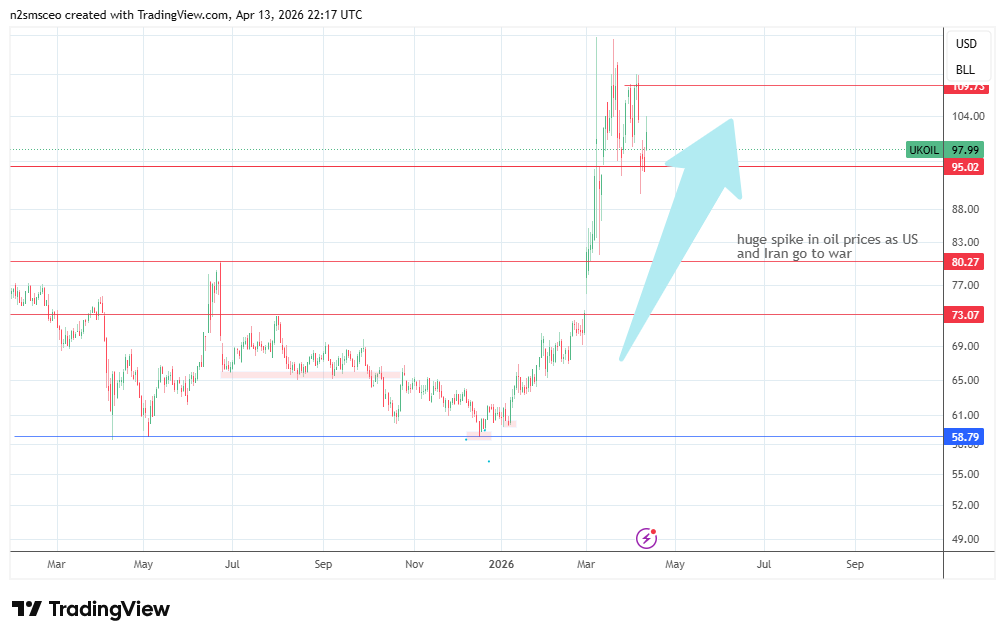
The year 2026 started with Brent crude oil predictions all decidedly bearish, given the global demand forecasts and oversupply conditions of the fourth quarter of 2025. All that changed in January 2026 with the US military raid on Venezuela, marking the beginning of a sequence of events that would severely rile the oil markets and the Brent crude oil outlook for 2026 and subsequent years.
Brent Crude Live Chart
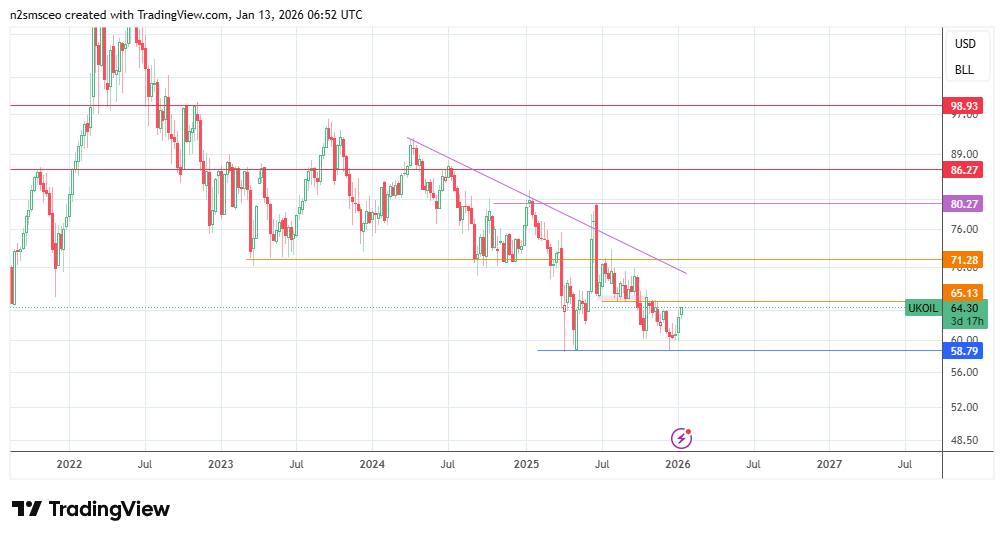
Compare the chart above, with the chart below to see how a single event has changed everything as far as Brent crude oil predictions are concerned.
Brent Crude Oil Predictions: Fundamental Drivers
Five interesting price drivers are shaping up to be the fundamental influences for Brent crude in 2026 and beyond. These are:
- Geopolitics
- Global risk sentiment
- OPEC Policy
- Sanctions/shadow supply Flows
- Supply and demand dynamics
1. Geopolitics/oil shock
Geopolitics has overtaken regular supply vs demand dynamics as the primary driver of crude oil prices as of April 2026. The US raid on Venezuela and the US-Iran war, coupled with the blockade of oil shipping at the Strait of Hormuz has added an oil risk premium to the mix. A Reuters report had analysts adding a $4 risk price premium due to the initial buildup and protests in Iran. This has been far outstripped by current realities as Brent crude remains above the $100 mark.
2. Global Risk Sentiment
Global economic conditions and growth outlook produce a risk-on/risk-off dynamic that impacts crude oil prices. Risk-off episodes could pressurize oil prices, especially if US-China tensions rear up once more.
3. OPEC Policy
A Reuters poll of oil traders indicates that OPEC policy will be one of the fundamental influences on traders’ watch in 2026, but on a much lesser scale as long as geopolitics remains the dominant driver. Oil prices gradually edged lower in 2025 after the oil cartel started lifting production curbs. Furthermore, demand from China following the trade dispute with the US added to the downward pressure on prices. The key factor to watch for is whether OPEC may be under pressure to defend a price floor.
3. Supply from Sanctioned Countries
The recent US action in Venezuela, the country with the world’s largest oil reserves, indicates a potential for a shift in the export outlook from there. This is a factor that could gain importance in the months to come.
Brent Crude Oil Prediction 2026: Institutional Targets
What are the Brent crude forecasts for 2026?
The Energy Information Administration had a $55 per barrel price target for 2026. A Reuters poll of 34 economists conducted in December 2025 indicated an average price of $61.27.
Institutional Brent crude oil forecasts have been updated in tandem with the oil shock regime. The main updated forecasts for 2026 are as follows.
Morgan Stanley has a Q2 2026 Brent crude price prediction of $110 per barrel, falling to $100 per barrel in Q3 2026 and $80/barrel in 2027. The bank assumes that oil supply chains would recover slowly even if Hormuz were to open now.
Goldman Sachs has cut its Q2 2026 forecasts from $99 to $90 per barrel, with prices falling to $82 and $80 per barrel in Q3 and Q4 2026. The bank says it is downgrading its forecasts on the basis of the temporary ceasefire and any signs of flow normalization. The bank still maintained its $ 115-per-barrel view if upside risk arises from continued Hormuz disruption.
Barclays sees an average price of $85/barrel in 2026, with its Q4 2026 forecast at $80/barrel. The bank bases its optimistic forecasts on faster recovery in Hormuz flows, while still maintaining that delays or further escalation pose upside risks.

Brent Crude Oil Prediction 2030
Institutional Brent crude oil predictions for 2030 come from Goldman Sachs, Equinor, UBS, and Shell.
Goldman Sachs has a long-term outlook/scenario pathway that sees Brent crude averaging $75 per barrel over the 2030-2035 period. UBS has a research-based outlook that projects a $28/barrel Brent crude price from 2028. Equinor has a long-term corporate outlook covering 2030-2040, and has set its Brent crude oil prediction at $75 per barrel.
Shell’s corporate modelling assumptions see Brent crude trading at $70/barrel. However, sister company BP calls for a 2030 target of $55 per barrel.
Brent Crude Oil Prediction 2040
Brent crude oil predictions for 2040 represent a long-term outlook outside the time frame of regular price outlooks from institutional entities. However, the outlook from Equinor carries into 2040, and so does that of Wood Mackenzie, which comes up as an end-of-decade Brent crude forecast of $100/barrel.
Brent Crude Technical Outlook
Brent crude is now in a two-way price move, driven by war headlines. The price is currently heading for a retest of the 93.23 support level.
If the bears break this support, a further decline towards 80.27 cannot be ruled out. Additional support levels at 73.07 are only attainable if the war headlines point towards a dramatic resolution.
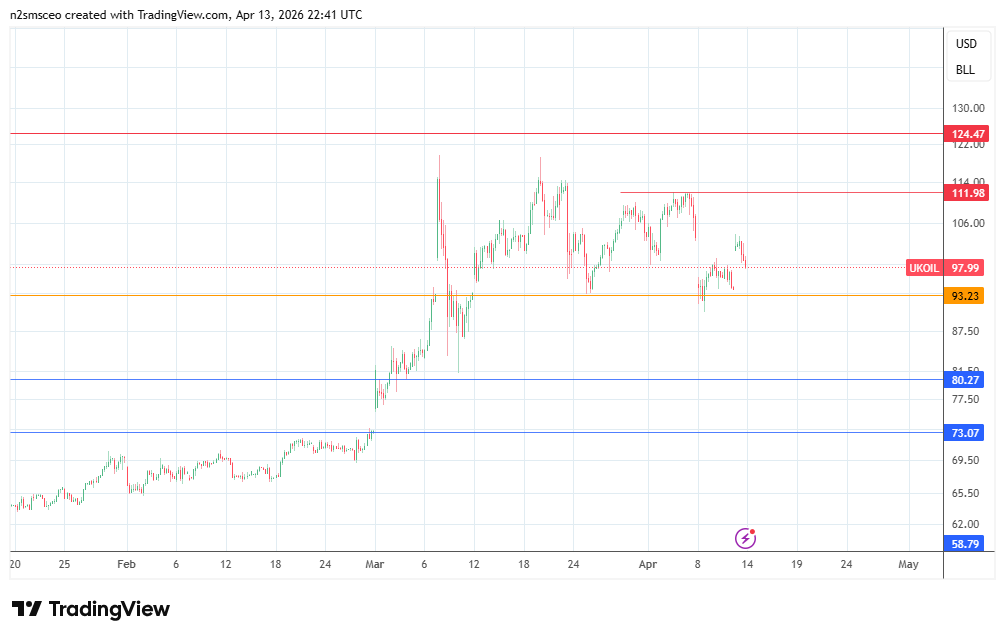
On the flip side, a bounce from the current support at 93.23 could lead to an upward push to reclaim the 111.98 resistance. Above this level, price could aim for a test of the 124.47 resistance level, which also marks the site of the 30 May 2022 high.
FAQ
What is the Brent crude price today?
As of 13 April 2026, Brent crude is currently trading at the $97.99 price mark.
What are the Brent crude oil predictions for 2026?
Many of the institutional Brent crude oil predictions call for prices to remain elevated and closer to the $100/barrel mark. This is at variance with the earlier projections that had Brent crude trading in the mid-$50s or low $60s per barrel.
Will the US invasion of Venezuela affect oil prices?
An initial knee-jerk reaction was followed by price stability, but the US-Iran war has upended everything about oil prices.
Why are oil prices trading higher?
This is because the Strait of Hormuz which houses 20% of global crude oil flows, has been closed for a while. This and the war have created an “oil shock” regime, with price trading above or near $100/barrel.

 AAPL
AAPL
 MSFT
MSFT META
META
 ^NDX
^NDX BTC-USD
 XRP-USD
 SUZLON.NS
 INR=X
INR=X EURUSD=X
 JPY=X
JPY=X CAD=X
CAD=X